
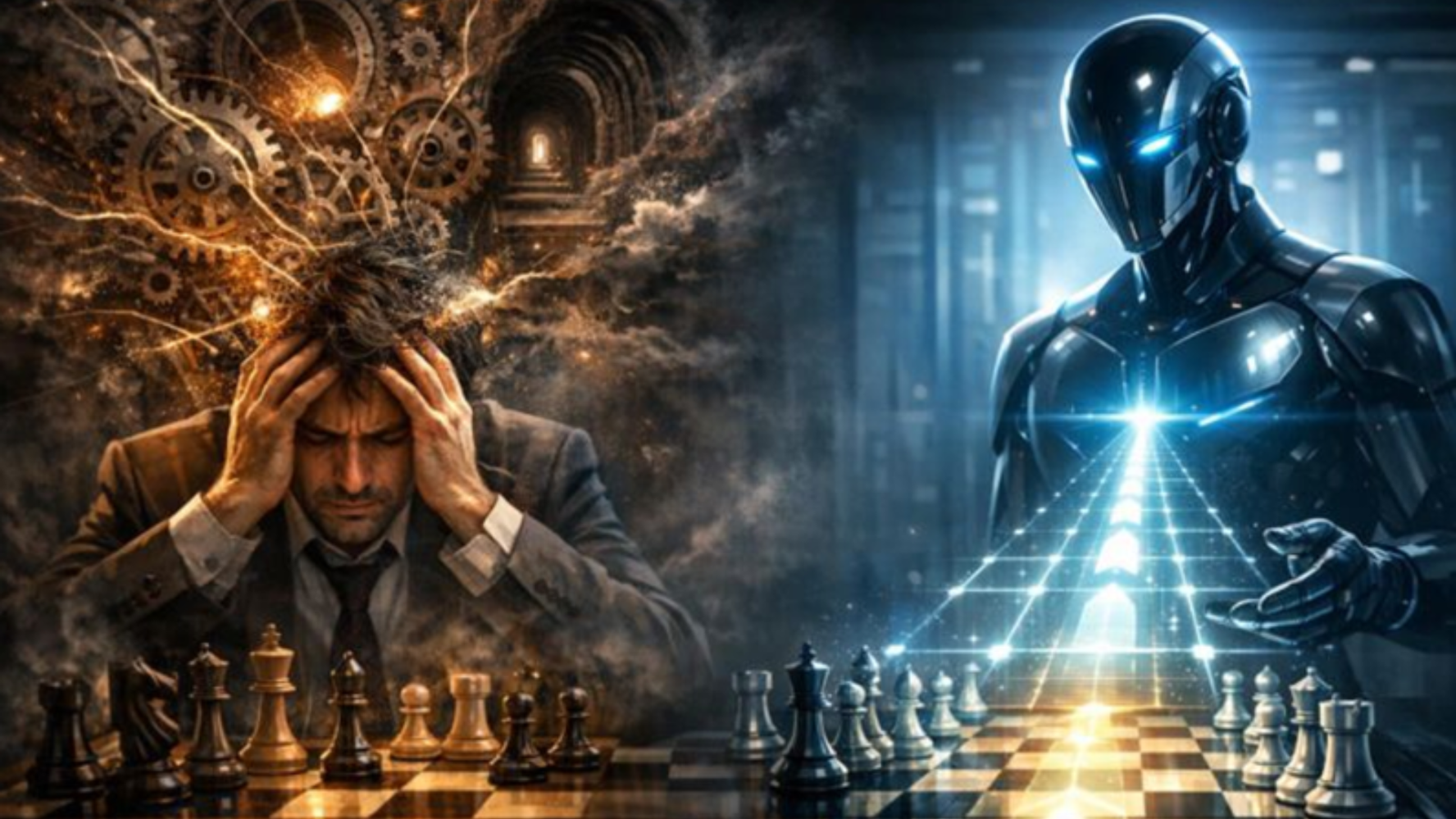
Introduction: The Unthinkable Blunder
In the high-stakes arena of elite chess, perfection is the baseline expectation. Yet, during the recent Uzbek Cup, the chess world witnessed an astonishing anomaly. Nodirbek Abdusattorov, one of the brightest stars in the global chess firmament and a cornerstone of Uzbekistan’s rapid rise as a chess superpower, made a catastrophic one-move blunder. In a completely open and clear position, he simply gave away his rook. It was a move that defied logic, representing a level of play perhaps 2000 rating points below his established baseline.
How does a recognized genius, operating at the absolute pinnacle of his discipline, make a mistake that a novice would spot instantly?
The answer does not lie in a sudden loss of chess knowledge. It lies in the architecture of the human brain. When we examine this blunder through the lens of cognitive psychology, we uncover profound lessons not just for chess players, but for SME founders, executives, and anyone navigating complex, high-pressure environments.
The Anatomy of a Blunder and “Tunnel Vision”
To understand Abdusattorov’s error, we must look to the academic literature on human cognition and decision-making. The Nobel laureate Daniel Kahneman, in his seminal work Thinking, Fast and Slow, outlines the dichotomy of human thought: System 1 (fast, instinctive, emotional) and System 2 (slower, more deliberative, and more logical).
In complex scenarios like a grandmaster chess game, players rely heavily on System 2 to calculate deep, branching variations of future moves. However, as cognitive load increases—due to time pressure, fatigue, or the sheer complexity of the calculation—the brain’s analytical bandwidth becomes depleted.
In chess psychology, this phenomenon is often linked to the apperception-restructuring view of errors (as explored in studies like those by Saariluoma P., Error in Chess: The Apperception-Restructuring View, Psychological Research, 1992). When calculating a sequence, a player forms a rigid mental representation of the board as it will be several moves in the future. If the opponent makes an unexpected move, the player, suffering from cognitive fatigue, may react to the imagined board state in their head rather than the physical reality in front of them.
This is “tunnel vision” or inattentional blindness. The drive to execute a preconceived plan becomes so overpowering that the brain literally fails to process contradictory visual data. The alarm bells that should ring when a rook is left hanging remain silent because the brain is operating in a different, imagined reality. As an International Correspondence Master, I have experienced this myself. You calculate five moves deep, and when reality diverges from your calculation, your exhausted brain fails to update its model.
The SME Founder as a Chess Professional
It is easy to view chess professionals solely as athletes of the mind. In reality, they are SME founders. A top-tier chess player is the CEO of a micro-enterprise where they are the product.
Like any small business owner, they must be aggressive generalists. They manage their own PR, negotiate sponsorships, handle travel logistics, and navigate complex federation politics. This external pressure acts as a constant drain on their cognitive resources.
Consider the recent, highly public dispute involving Kazakh female chess star Bibisara Assaubayeva—partner of another rising Uzbek star, Javokhir Sindarov. The conflict centered around the allocation of sports funding and the perceived lack of financial support for elite chess players from national bodies. This is a classic “small business” stressor. When a professional is consumed by existential financial concerns or political battles, that stress occupies a significant portion of their “System 2” processing power.
When they finally sit down at the board, their cognitive reserves are already depleted. The pressure of defending a crown against rising peers—as Nodirbek faces with Sindarov—only compounds the load. The resulting blunders are not failures of talent; they are symptoms of a system pushed beyond its operational limits. The exact same dynamic destroys SME companies when founders try to multitask their way through complex operational, financial, and strategic challenges.
The Ultimate Consequence of Protocol Failure
In chess, a cognitive failure costs you a game. In business, it can cost you your company. In extreme physical environments, it costs lives.
The tragic reality of human error was starkly highlighted recently by the devastating news from Brazil, where a 21-year-old woman lost her life during a bungee jump. The fatal cause? The operational team, likely suffering from routine fatigue or distraction, simply forgot to properly attach her to the safety rope.
This horrifying incident underscores a universal truth: human beings, no matter how well-trained, are fundamentally fallible. When speed, routine, or cognitive overload takes over, mistakes are inevitable. Relying solely on human vigilance in high-stakes situations is a mathematical guarantee of eventual failure.
SME companies often operate without a safety net. A single catastrophic error—misallocating capital, failing a compliance audit, or misjudging a market shift due to founder fatigue—can result in immediate insolvency. They lack the financial stamina of large corporations to absorb the impact of a “blunder.”
The “Man with Machine” Solution
If human cognitive failure is inevitable, what is the solution? The answer lies in systemic safeguards and algorithmic discipline. You cannot out-think cognitive fatigue; you must out-system it.
This is the foundational philosophy behind the One4All Group and our approach to both business and chess. It is why we champion the “Man with Machine” paradigm.
In our investment operations, we do not rely on “gut feeling” or human intuition, which are highly susceptible to emotional bias and tunnel vision. Instead, we utilize the Quantiple-Monica Integrated Investment System (QMIIS)—a rigid, mathematically sound qualitative valuation engine that enhances our quantitative Markowitz-van Dijk model. The QMIIS protocol filters out the noise, ignores the emotional narrative, and evaluates data with cold precision.
Similarly, in our advisory work with SMEs, we integrate AI as a critical productivity tool. AI does not get tired. It does not suffer from inattentional blindness. It does not get distracted by federation politics or funding disputes. By offloading complex, repetitive, or data-heavy tasks to AI systems, human founders can preserve their precious “System 2” bandwidth for true strategic leadership.
However, it would be wrong for humans to believe that such a system would ‘solve everything’. Anyone who has worked with AI knows about hallucinations of the system. Meaning that in such a system knowledgeable humans need to overlook what the engines do. And yep: this implies that 100 percent guarantees of error avoidance cannot be given. Not when humans have the lead. And not when engines/computers take over.
Conclusion
Nodirbek Abdusattorov will recover from his blunder. He is a phenomenal talent, and this is merely a painful lesson in the limits of human cognition. But for the rest of us—whether we are navigating the complexities of the chessboard, the volatility of private markets, or the daily grind of running an SME—the lesson is clear.
Acknowledge your human limitations. Respect the devastating potential of cognitive overload. And build the systems, protocols, and AI integrations necessary to protect yourself from your own mind. Although you have to also make sure that you supervise. And avoid typical AI-/engine errors!
This video shows what happened. Keep in mind that chess super grandmasters are in an extremely difficult situation: the whole world will immediately know about their blunder. But we all commit mistakes. And most likely, way more in our work than super chess grandmasters in theirs. It is just that ours are not that visible for the whole world.