

Introduction: The View From The Inside
As the CEO of One4All Group and Chief Investment Officer of the Quantiple Family Office network, I am frequently asked how we navigate periods of intense geopolitical turbulence. Between March and June 2026, as tensions in the Middle East dominated headlines, our response was deliberate: a “Strategic Pause.”
This was not passivity. It was a highly disciplined, quantitative maneuver based on the proprietary Markowitz-van Dijk model. Today, I am sharing the applied realities of this framework. Whether you are an SME founder, a professional, or a fellow Family Office director, the lesson remains the same:
“mathematical probability must always override emotional noise”
The World Cup Metaphor: Probability vs. Emotion
In times of excitement or panic, human beings drastically overweigh the short-term and ignore baseline probabilities. Consider the 2026 World Cup, where traditional powerhouses like the Netherlands and Germany were eliminated by Morocco and Paraguay in the round of 32. In Europe, the emotional expectation of success (and that was about an overall tournament victory!) was close to a coin toss or even higher:>50%.
However, pure quantitative logic dictates otherwise. In a tournament of 48 teams (after reaching the round of 32), the baseline probability of any single team advancing through the knockout stages as tournament winner is roughly 1/32 (or approximately 3%). Of course: this assumes that all participants are equally good; and that is most certainly not the case. However: expecting a 50% outcome is a monumental mathematical distortion—a 17x overweighting driven purely by nationalistic emotion. But even when using upfront information regarding the difference in playing strength (e.g. the FIFA country world rankings), a 17x overweight is insane.
The exact same psychological flaw plagues financial markets during geopolitical events. Investors overreact to the immediate news cycle and under-incorporate long-term realities. The luxury of patience is earned by maintaining a diversified portfolio and purchasing proper insurance (e.g., bought put options) before the panic sets in.
Institutional Bias and the Need for Objective Data
During the Q2 turbulence, we observed a stark divergence between the reality on the ground in the UAE (overlooking the Strait of Hormuz, like in my house) and the narrative pushed by Western media. This is not a political grievance; it is an economic observation.
When developed economies face stagnating growth, high inflation (often exacerbated by their own tariffs and taxes), and a loss of competitive advantage, there is an institutional tendency to blame external factors. Furthermore, massive institutional investors suffer from principal-agent problems. Managing billions, they cannot efficiently allocate capital to the most agile, high-performing SMEs. They herd into safe, oversized assets and rewrite the narrative to justify their underperformance.
At Quantiple, we invest our own capital. We eat the returns and feel the pain of failure. Therefore, we require absolute, unvarnished truth.
The AI Advantage: Replacing the CIA Factbook
To strip away this institutional bias, we have integrated advanced AI into our quantitative macro-analysis. The AI incorporation is extremely useful when trying to evaluate and weigh recent qualitative news in such a manner, that its outcome can be integrated with quantitative analysis of fundamentals. Following the discontinuation of the CIA Factbook by the Trump government, we also engineered a proprietary AI system that synthesizes data from the World Bank, Heritage Foundation, Crunchbase and Wikipedia Country Pages.
This engine generates a dynamic, 6-pillar qualitative score for every nation: Economy, Politics, Demographics, Geography, History, and Culture. Integrated directly into our quantitative models, it ensures our capital allocation is driven by data, not media narratives. And also important: the information is analyzed from the perspective of investors interested in investing in publicly-listed and private companies in the respective countries.
We believe that without structured approaches like ours, it is almost impossible not to be one way or another caught by the shorter-term storms that hit markets as a result of economic, financial and/or geopolitical news.
The UAE Pivot: A 2.5 Billion Consumer Market

Our objective data confirms a massive, long-term structural shift. The UAE is rapidly transitioning from a traditional OPEC energy producer into the premier financial hub—the Singapore or Luxembourg of the Middle East. As Indian, Asian and African long-term economic growth becomes unstoppable, hubs like ADGM and DIFC are pivoting to serve a combined MENA-Africa-Asia market of over 2.5 billion consumers. For founders and Family Offices, the strategic imperative to establish a presence here has never been stronger.
Portfolio Mechanics: The 2/3 vs. 1/3 Architecture
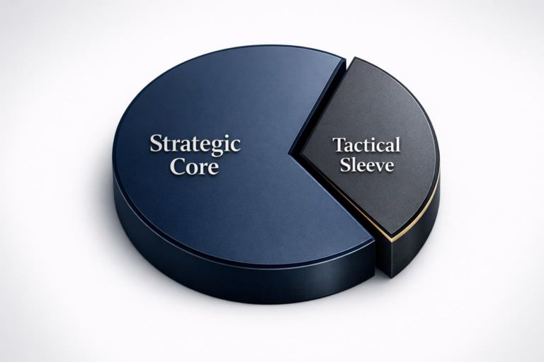
How does this translate to execution? We utilize a barbell approach:
- The Strategic Core (2/3): Allocated to long-term, top-tier holdings measured in years. We have reduced the total number of holdings, demanding exceptional quality—much like an elite university with a massive barrier to entry. For our highest-conviction Tech and Emerging Market assets, we no longer exit fully on success; we trim and let the winners run. But we will also allow for Deep Value opportunities that arise when companies with good long-term recovery prospects are unfairly beaten by markets in the shorter term.
- The Tactical Sleeve (1/3): Allocated to shorter-term horizons (weeks/months) to capitalize on the exact market dislocations caused by the emotional herd during periods of excess volatility.
During the Q2 panic, we increased our super-liquidity, accepting a 3% yield on our fixed income instead of our standard 6% (annualized returns). Over four months, this “cost of insurance” was a mere 1%. That 1%bought us the ultimate luxury: the ability to sit on our hands, wait for the noise to clear, and act decisively when others were paralyzed.

The Private Market Frontier
The same principles apply to private markets. Deal flow and funding requests are incredible leading indicators of institutional mindset. However, end-investors do not want to sift through hundreds of unvetted pitches.
To solve this, we are currently developing a proprietary private market curation ecosystem. Built by investors, for investors, this app will utilize our AI and quantitative models to connect real capital with curated deal flow, entirely bypassing fee-extracting intermediaries.
Conclusion
Volatility is the price of admission, but panic is strictly optional. At One4All Group, we equip our partners to navigate both. Whether you are a professional utilizing our SME Training, a founder setting up in the UAE via One4All Global, or a Family Office looking to exchange high-level insights, the foundation is the same: Theory. Practice. Mastery.